28 Oct 2026 · Paper · PLoS Computational Biology
Individualised electrophysiological neural field models for the assessment of thalamocortical function in disorders of consciousness
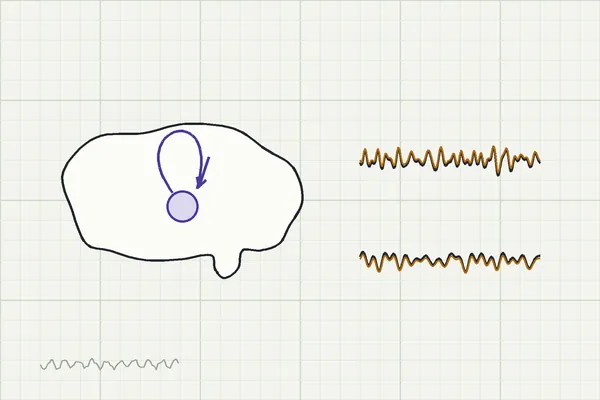
A brain model fitted only to EEG power reproduced the complexity scores that separate patients.
Researchers fitted a model of the loop between the thalamus and the cortex to the EEG of more than 500 people with severe brain injury or none. The fitted loops were weaker in patients, weakest in the least responsive. The model was fitted only to how much power the EEG had at each frequency, yet the signals it produced had the same complexity scores as the real ones.
Two independent high-density EEG datasets: 203 UWS, 270 MCS, 74 controls. Robinson corticothalamic neural field model fitted per person to spectra. Reduced corticothalamic integrity, UWS < MCS. Simulated EEG reproduced empirical complexity; permutation entropy separated MCS from UWS in real and simulated data. Code and replication data on GitHub.
What we do with it
Support for our main caution: if a model fitted to the spectrum reproduces a complexity score, that score adds little beyond the spectrum. We will check whether the shared replication data include per-patient spectra. Planned
Read the original. Source checked against the original.