20 Aug 2026 · Preprint · bioRxiv
Neural signatures of conscious experience during sleep: a serial awakening study using high-density EEG
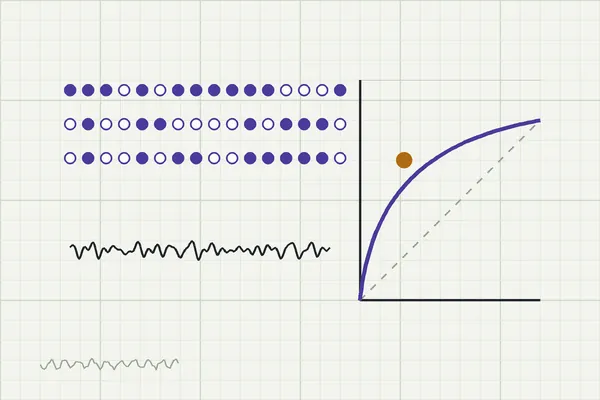
A large sleep study reports that one minute of EEG can tell a dream from no dream about 80% of the time.
A team woke 140 people about 700 times from non-REM sleep and asked whether anything had been going through their minds. Half the time the answer was yes. A computer, trained on the minute of brain signals before each awakening, picked the yes answers well above chance. Dreaming went with less slow activity and more fast activity at the back of the head. The study mixed light and deep sleep, and deep sleep is where 'nothing' answers are most common, so part of the signal may be sleep depth.
140 participants, 256-channel EEG, 699 N2 and N3 awakenings (351 experience, 348 no experience). Features from the 60 s before awakening: regional spectral power, lagged coherence, graph metrics, gamma/alpha ratios. Participant-level cross-validation. Best ensemble ROC-AUC 0.80, average precision 0.80. Dreaming: lower posterior alpha and delta, higher gamma-related measures. N2 and N3 pooled; one lab; no spectral-baseline nesting or surrogate control. Not peer reviewed. (abstract only; the full text was behind a bot block, which we did not get around)
What we do with it
This is the strongest claim yet that our main study could come out the other way. Our benchmark holds stage fixed, tests in labs never used for training, and asks what each marker adds over the spectrum. We will report the spectral baseline's own score as a headline number, so a strong spectral result is visible, not hidden. Planned
Read the original. Source checked against the original.