22 Oct 2026 · Preprint · bioRxiv
Inferring brain structural complexity from dynamical measures
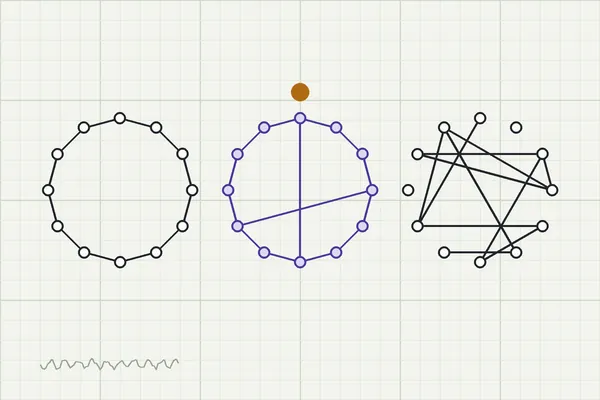
In simulated brains, pulse-based complexity tracked the wiring; measures of resting activity did not agree with each other.
The team built simulated brains whose wiring they could change step by step, from orderly to random. Measures based on giving the network a kick peaked when wiring was in between, as theory expects. Measures taken from resting activity went different ways: some followed one property of the wiring, some another, some hardly moved.
Wilson-Cowan mean-field networks with systematic rewiring. Observational metrics were heterogeneous (integration-tracking, differentiation-tracking, or insensitive). Perturbational metrics peaked at intermediate rewiring, scaled with small-worldness, resisted common-driver confounds and were highest near a wake-like regime. Simulation only; not peer reviewed. (abstract only)
What we do with it
A model-based reason the resting-EEG markers in our benchmark may fail. It also suggests a positive control we could add later: plant known wiring in a simulation and check each marker can see it. Planned
Read the original. Source checked against the original.